
Armageddon 1.0
No More Room in Hell 2 1.0 Features Guide
Explore no more room in hell 2 1.0 features: nine maps, two modes, solo practice, crossplay, four difficulties, progression, and Rescue Beacons.
 Official 1.0 Launch Trailer
Watch the Armageddon launch overview.
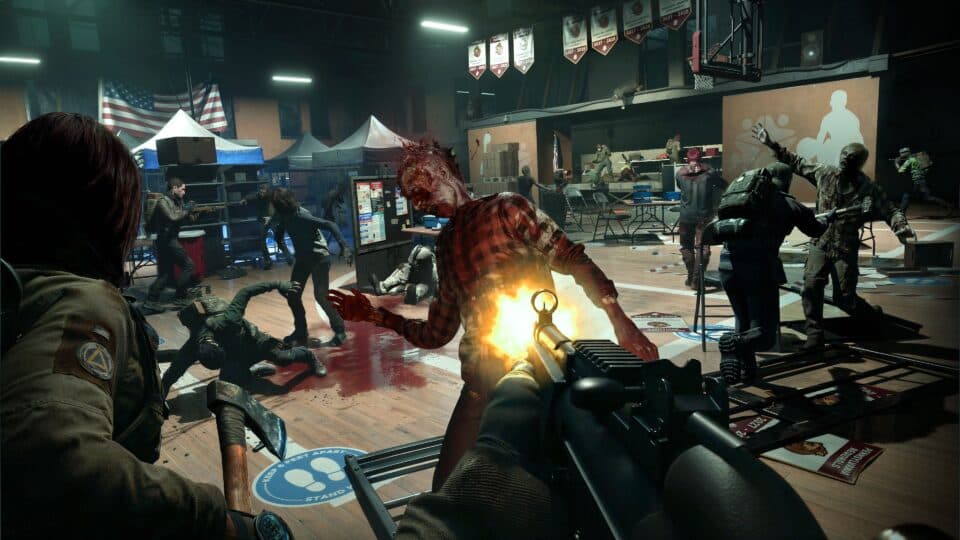
Watch on YouTubeNo More Room in Hell 2 version 1.0, named Armageddon, includes two modes, nine maps, thirty-eight weapons, ten zombie types, four difficulties, and up to eight-player crossplay. It also adds Solo practice, a guided tutorial, achievements, weekly assignments, Merits, expanded Responder customization, and Rescue Beacons. Armageddon launched on August 11, 2026 for PC, PS5, and Xbox Series X|S.
The 1.0 content scale
The official 1.0 material lists six Objective maps and three Survival maps. It reports thirty-eight weapons, ten zombie types, four difficulty settings, and thirty-five Steam achievements. Online co-op supports up to eight players across the currently supported PC and console platforms.
Those totals describe the Armageddon release baseline, not a guarantee that every later update will keep the same count. Current post-launch totals after August 20, 2026 are 待确认. This page therefore uses version 1.0 as its explicit scope.
| Feature | Version 1.0 total | | --- | ---: | | Game modes | 2 | | Maps | 9 | | Weapons | 38 | | Zombie types | 10 | | Difficulty levels | 4 | | Steam achievements | 35 | | Online squad size | Up to 8 |
Objective Mode
Objective Mode sends Responders through a sequence of Civil Recovery Corps tasks before a high-risk final extraction. Its six maps are Power Plant, Pottsville, Lewiston, Broadway, Beaulieu Hospital, and Raven Rock. The returning maps received route, objective, loot, zombie-pressure, extraction, and performance changes for 1.0.
Power Plant remains the original rural Pennsylvania scenario, while Pottsville and Lewiston use town routes and multiple mission spaces. Broadway focuses on a failed city extraction, Beaulieu Hospital uses medical-facility objectives, and Raven Rock moves into a restricted underground military installation. The precise route can vary with objectives, so a memorized Early Access shortcut is not always valid.
Objective difficulty scales with the number of remaining players at the start of an encounter. That makes separation and early deaths affect more than raw squad damage. The mode’s progression value also depends on reaching final extraction with supplies rather than treating every carried object as permanent stash loot.
Survival Mode
Survival Mode uses Flooded, Lighthouse, and Night of the Living Dead. Each map contains three possible points of interest, and the team receives preparation time plus a supply drop before a speaker defense. A defense wave lasts five minutes, after which a successful squad receives another drop and moves to the next location.
Three successful waves call the final helicopter. Failing two waves opens early extraction, giving surviving Responders a way to avoid a complete loss. This produces a shorter, defense-focused loop than the longer task chain in Objective Mode.
Flooded changes visibility and movement with water across an industrial site. Lighthouse combines cliff edges, tight interior spaces, a neighborhood, and construction areas. Night of the Living Dead expands a farmhouse defense into a farmstead with a guest house and barn, each offering different defensive tradeoffs.
Solo Mode and tutorial
Solo Mode lets one player learn maps, practice objectives, explore routes, test combat, and use a geared Responder without permanent-death risk. Traditional character progression is disabled, so the mode does not reproduce the normal co-op reward loop. It is a practice sandbox, not a confirmed offline story campaign.
The guided tutorial covers melee, ranged combat, objectives, and inventory management. A Training Range provides weapons, ammunition, medical items, and objective practice. These additions give new players a safer path into a game whose main progression remains tied to co-op extraction.
Solo launch notes mentioned a console issue where Beginner supply drops could fail to appear. That report belongs to the launch window, and its status after subsequent updates is 待确认. Players should check the current patch notes before treating it as an active limitation.
Four reworked difficulties
Beginner reduces effective zombie health by thirty percent, keeps teaching UI visible, and normally returns dead players every minute. Normal respawns players after major objectives and increases Character XP. Both can still produce permanent loss if the entire team wipes before a respawn point or if a player dies after extraction has been called.
Hard disables normal respawning and increases Account XP, Character XP, and Credits. Nightmare also disables respawning, adds more special-zombie pressure, makes resources scarcer, and applies the highest reward multipliers. These settings change the risk model, not only enemy durability.
Choose Beginner to learn interfaces and objectives, then Normal for the standard growth loop. Hard and Nightmare reward planned roles, medical coverage, noise control, and an extraction plan. A raw weapon tier list cannot replace those squad decisions.
Permadeath and Rescue Beacon
Responders carry individual levels, Skills, loadouts, appearance, and permanent-death exposure. Hard and Nightmare place that investment at risk from deployment, while Beginner and Normal add limited recovery rules. Full death must also be separated from the downed state, where a teammate may still perform a revive.
The Rescue Beacon is a consumable loadout item that prevents the next qualifying loss. It occupies a slot and can be bought with Credits or Merits. It is insurance for one protected event, not permanent immortality for the roster.
Because a Beacon competes with other equipment for loadout space, its value rises with character investment and difficulty. A fresh practice run and a developed Nightmare Responder do not face the same expected loss. Current prices after launch-week tuning are 待确认 unless shown by the live game.
Progression, weekly assignments, and customization
Account progression unlocks broader access to gear and Skills, while individual Responders build their own character progression. Credits pay for loadout items, Skill upgrades, rerolls, and cosmetics. Merits come from play and can purchase selected cosmetics or a Rescue Beacon.
Weekly Assignments reset on Tuesdays. Four assignments are available, three of them award one Merit plus Credits, and the larger weekly goal awards three Merits. The exact current assignment objectives are 待确认 because they rotate.
Armageddon added more outfits, Compass and Flashlight cosmetic categories, revised cosmetic prices, sorted unlock requirements, and the Wright voice set. It also reset old account progression, Credits, Responders, loadouts, Skills, and non-Early-Access cosmetics for the 1.0 transition. That reset is a historical release event rather than a recurring weekly wipe.
Combat and technical changes
Armageddon adjusted firearm behavior, melee attack speed and damage, stability, Skills, sprinting, shove stamina, ammunition spawns, Tier 3 weapon placement, zombie pressure, and extraction timing. It also revised routes or objectives across the five returning Objective maps. Advice written before the update must be checked against these changes.
On supported hardware, version 1.0 added DLSS 4.5 and Frame Generation for compatible RTX 4000 and 5000 cards. The release also improved gore and impact rendering, collision, foliage, audio, 5.1 surround, loading, interface behavior, server systems, navigation, and reconnect behavior for some map-load crashes. An Unstuck function was added for movement problems.
These improvements do not prove that every launch issue is resolved. The official launch notes documented crashes, server instability, hitching, UI problems, texture issues, and memory concerns, while later hotfixes addressed several of them. The present status of any specific bug not covered by a newer official note is 待确认.